

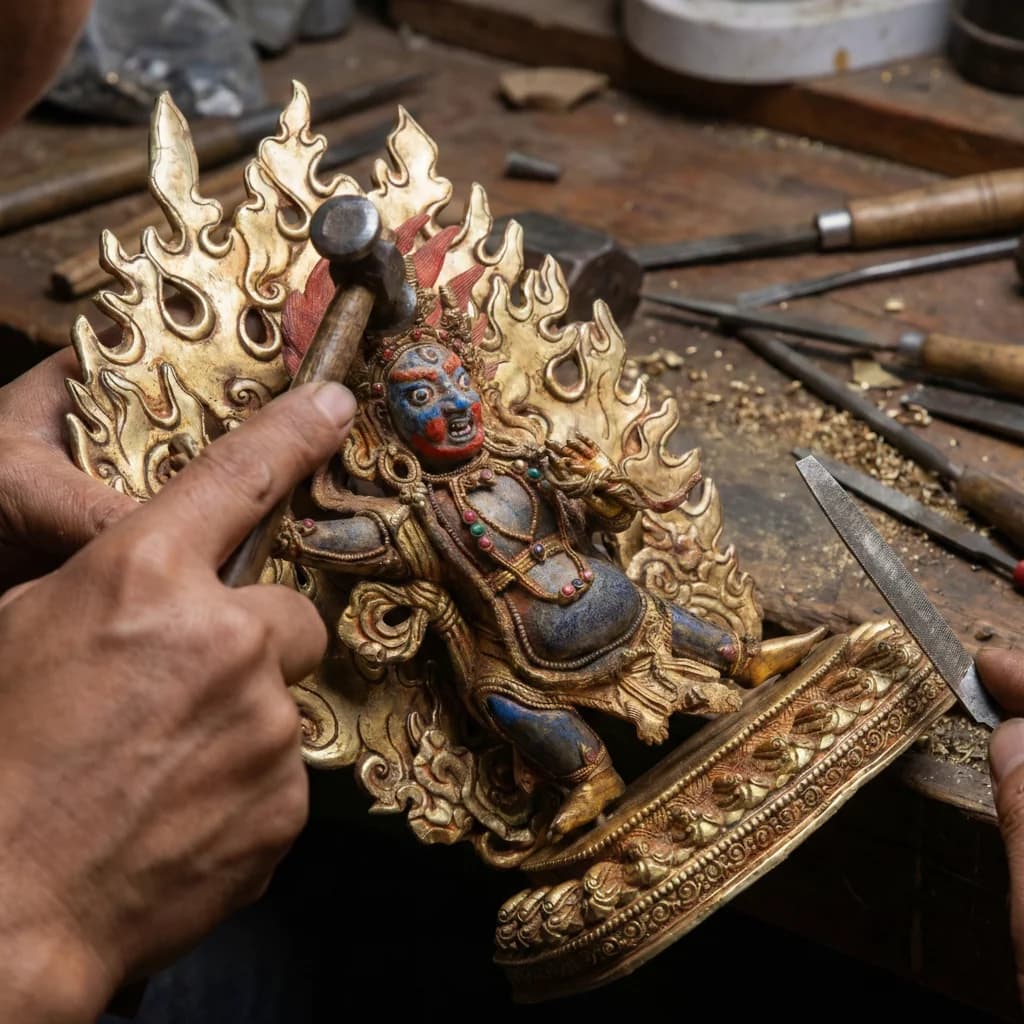
Craft as inheritance
In Nepal, craft has rarely been a career choice. It has been an inheritance.
Within the Newar communities of the Kathmandu Valley, particular skills belonged to particular lineages, and the knowledge moved down the family rather than through a school. The Shakya and Bajracharya families cast and worked precious metal. The Tamrakar worked copper. The Chitrakar painted. The Silpakar carved wood. The Prajapati turned clay. These are not job titles; they are family names still carried by the people doing the work today.
Around those families sat the guthi, the community trusts that maintained the temples, funded the festivals and, in doing so, kept the craftsmen commissioned. A carver had a reason to carve because the city needed its window screens repaired and its shrines renewed. The craft and the culture held each other up.
A great deal has changed. But when you buy a cast brass lamp from Patan today, there is a reasonable chance it came from a workshop where the same family has been casting metal for longer than most European countries have existed in their current borders. That continuity is the thing we are trying to protect.
Where the work is made
Nepali craft is intensely local. Skills cluster in specific towns, and the town tells you a great deal about the piece.
- Patan (Lalitpur) — metal
- The oldest and most respected metal-casting quarter in the Himalaya. Lost-wax casting, repoussé, chasing and fine finishing. Ritual lamps, water vessels, bowls, deity figures. Patan workshops supplied the wider Himalayan region for centuries, which is precisely why so much of their output is now mistaken for Tibetan.
- Bhaktapur — wood and clay
- A city built of carved timber. The famous Peacock Window belongs to Bhaktapur, and the carving language developed for its buildings — deep, layered, architectural relief — carries into the panels, frames and decorative pieces made there now. Bhaktapur and neighbouring Thimi are also Nepal's pottery centres, still throwing and firing by traditional method.
- Kathmandu — painting
- The Newar paubha tradition, painted in mineral pigment and gold on prepared cotton. Distinct from the Tibetan thangka in composition, palette and iconography, and older as a documented lineage.
- The hills — fibre
- Dhaka cloth with its sharp geometric patterning, handwoven in the mid-hills. Allo, spun and woven from the Himalayan giant nettle by hill communities who harvest and process the fibre themselves. Lokta paper, made from the bark of a mountain shrub that regrows after cutting, and used for Nepal's official documents long before it reached anyone's stationery shelf.
- The Terai — Mithila painting
- From the southern plains around Janakpur, a tradition of bold line and flat colour practised largely by women, painted originally on the walls and floors of the home for weddings and festivals. It has no Tibetan connection whatsoever, and it is one of the clearest illustrations of how varied Nepali craft actually is.
Why it takes as long as it takes
A carved panel can take weeks. A cast figure moves between a wax modeller, a caster, a chaser and a finisher before anyone can call it done, and each of those people is waiting on the one before. A patterned weave is measured in centimetres per hour.
None of this is inefficiency. It is the actual cost of making something by hand, and it is the reason a genuine piece is priced differently from a mould-pressed copy. When you buy from us, most of what you are paying for is time: a person's attention, held on one object, for days.
The marks of the hand
Your piece will not be perfect, and it is not supposed to be.
Hammer marks will vary slightly in depth. A carved line will be a hair deeper on one side than the other. Two lamps of the same design will differ a little in weight and tone. Natural dye varies between batches, and hand-spun fibre varies along its own length.
Small variations are not flaws. They are the signature of the person who made it, and they are the simplest proof that a machine was not involved.
How the skill survives
A carver typically starts young, sweeping the workshop, sharpening tools, watching. Then simple repeated elements. Then, after years, the parts of a piece that show. The knowledge transfers by watching and correction rather than by instruction, which is why it cannot be written down and cannot be recovered once a generation skips it.
That is the honest risk here. These skills are under real pressure: from cheap imported reproductions, from the fact that a young person in Nepal can often earn more abroad in a year than at a workbench in five, and from the mislabelling that strips Nepali makers of the recognition that would let them charge what the work is worth.
A craft tradition does not end dramatically. It ends when a master has no one to teach.
Every order placed with us is one more reason for a workshop to keep an apprentice on. That is not a marketing line. It is the arithmetic of the business.
Our commitment to the people who make our work
- Direct relationships
- We buy from the workshop, not through a chain of agents. Fewer hands between the maker and you means more of the price reaches the person who earned it.
- Fair, agreed pricing
- Our artisans quote for their work and we pay it. We do not run reverse auctions or push prices down on repeat orders.
- Honest attribution
- Where a maker or workshop is willing to be named, we name them. Where a tradition is shared across the Himalaya, we say so plainly instead of blurring it into "Himalayan".
- No production pressure
- We would rather tell a customer to wait than ask a workshop to hurry. Deadlines are the first thing that damages quality in handwork.
- Continuity over volume
- We place steady, repeat orders with a small number of workshops rather than large one-off orders spread wide. Predictable work is what allows a master to take on and keep an apprentice.