

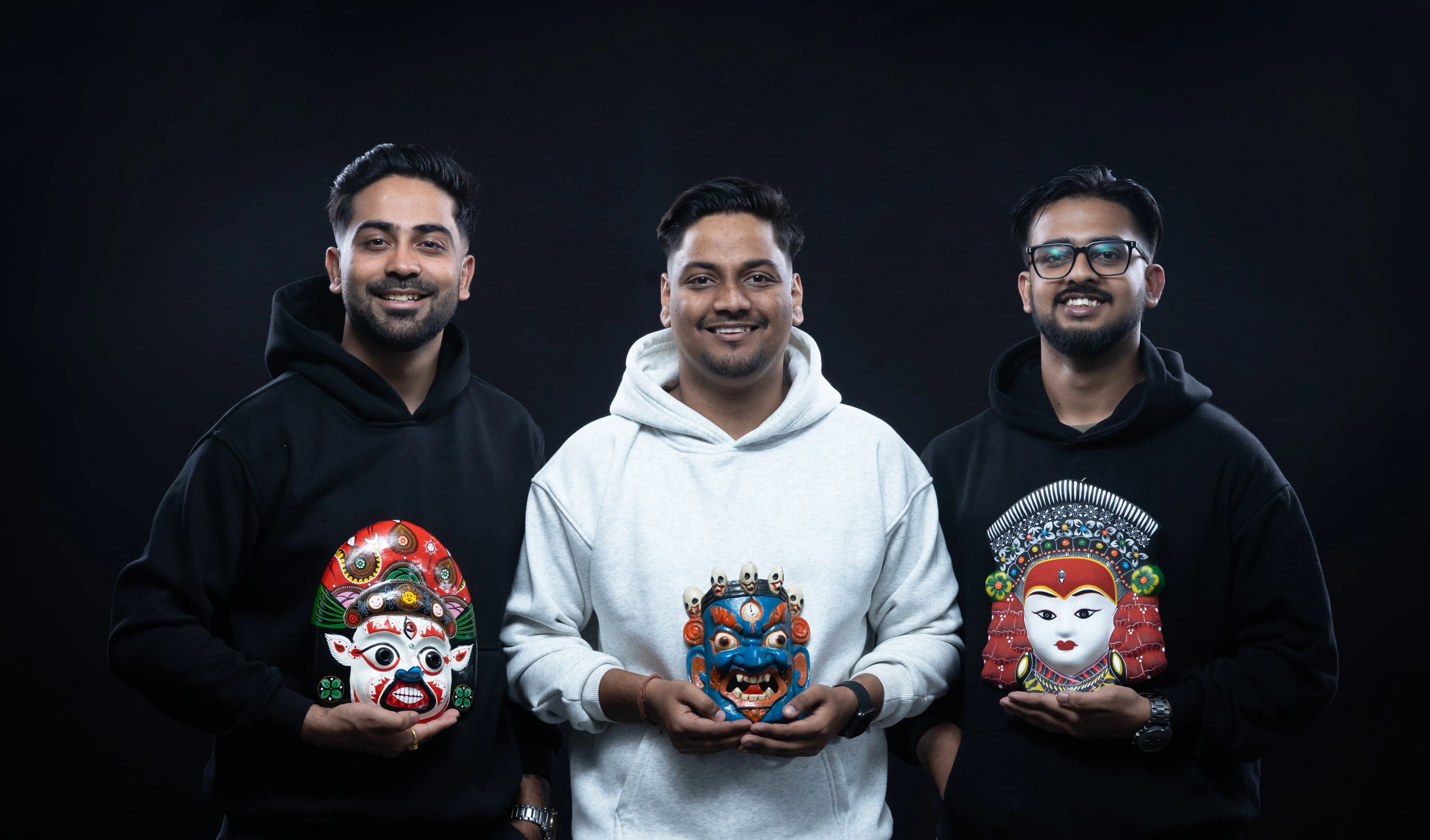
Three brothers, one intention
Kumari Decors began with three brothers and a frustration we could not let go of.
We grew up around Nepali craft. It was in the carved struts holding up the temple roofs of our neighbourhood, in the brass water vessels in our mother's kitchen, in the woven blankets that came out when the Kathmandu winter arrived. It was ordinary to us, the way a thing is ordinary when it has always simply been there.
Then we came North. We saw Nepali work in European shops, in catalogues, in interior magazines. And again and again it carried someone else's label. A Newar wood carving described as Tibetan-style. A paubha painting from Patan sold as a Tibetan thangka. A Kathmandu Valley statue filed under Himalayan and left at that, as though the entire mountain range were a single country with a single hand.
Nothing about that is malicious. It is simply a gap in knowledge, and gaps get filled by whatever name travels fastest.
So we started Kumari Decors to fill it properly. Not to compete with Tibetan craft, which we hold in deep respect, but to make sure Nepali craft is recognised as Nepali: made in Nepal, by Nepali artisans, in traditions that belong to Nepal.
Every piece we ship carries a name, a place, and a story. That is the whole point of us.
Why we are called Kumari
In Kathmandu, the Kumari is a living goddess: a young girl recognised as the earthly embodiment of divine feminine power, who lives in her own palace in the heart of the old city and appears before the public on festival days.
We chose her name for two reasons.
The first is that she is unmistakably ours. There is no equivalent tradition anywhere else in the world. She is Nepal, and specifically the Kathmandu Valley, in a way nothing else quite is.
The second is what she represents: the sacred living inside daily life. She is not kept in a museum. She sits in a wooden house with carved windows, in a busy square, surrounded by people going about their day. That is exactly how we think about the objects we sell. A handmade thing should not be treated as an untouchable artefact. It should live in your home, catch the light in the afternoon, and be part of your everyday.
Nepali craft is not Tibetan craft
This is the part of our story we care about most, so we would like to be specific.
Nepal and Tibet have exchanged artistic ideas across the Himalaya for more than a thousand years. Buddhism, iconography, materials and technique all crossed the passes in both directions. The two traditions are related. They are not the same, and the influence has never run in only one direction.
In the 13th century, a young Newar artist from the Kathmandu Valley known as Araniko was sent north with a delegation of craftsmen. He worked in Tibet, then travelled on to the Yuan court in China, where he became the leading artist of the imperial workshops and built the great white stupa that still stands in Beijing. He was one of many. For centuries, Newar metal casters and painters from the Kathmandu Valley were the sought-after masters of the wider Himalayan region, and their workshops shaped the visual language that later spread across Tibet.
Some of the differences you can see with your own eyes:
- Painting
- The Newar tradition of the Kathmandu Valley is called paubha. It is denser and more geometrically ordered than a Tibetan thangka, with tighter registers of figures, a distinctive red-dominant palette, and often a donor panel at the base recording who commissioned the work. Thangkas are typically mounted in brocade silk and built around more open, atmospheric landscape space.
- Wood
- Nepali wood carving is architectural in its instincts. It comes from a valley where entire cities were built of brick and carved timber: window screens, roof struts, doorway toranas, all worked in deep, layered relief. The famous Peacock Window of Bhaktapur is the emblem of that tradition. It is a carving language developed for buildings, and it carries into smaller decorative pieces.
- Metal
- The workshops of Patan have practised lost-wax casting and repoussé for generations, producing a particular finesse of surface detail and a family of forms — ritual lamps, water vessels, singing bowls, deity figures — that are Nepali in proportion and finish.
- Textiles and fibre
- Dhaka weave with its geometric patterning, allo cloth spun from Himalayan nettle, lokta paper made from the bark of a mountain shrub, and Mithila painting from the southern plains. None of these are Tibetan. They are regional Nepali traditions, several of them from communities with no Tibetan connection at all.
We are not asking anyone to memorise this. We only want the label to be right. When a Nepali maker's work is credited to another culture, the maker loses the recognition, and the buyer loses the real story.
What we bring into your home
- Hand-painted wood carving
- Architectural relief work, panels, frames and decorative objects, carved and painted by hand in the Kathmandu Valley tradition.
- Ethically sourced textiles
- Handwoven cloth, throws and cushions in natural fibres, made on traditional looms.
- Traditional metalwork
- Cast and hammered brass, bronze and copper: lamps, vessels, bowls and figures from workshops that have practised these methods for generations.
- Ritual and spiritual objects
- Pieces made for meditation, ceremony and quiet daily practice, offered with an explanation of what they are and how they are traditionally used, so they can be lived with respectfully.
Craft that belongs in a Nordic room
People sometimes assume Himalayan craft and Scandinavian interiors are opposites. We have found the opposite is true.
Both traditions are built on natural material honestly used. Both value the visible mark of the maker. Both prefer one good object to five disposable ones. Where Nordic design brings restraint, light and clean geometry, Nepali craft brings depth, warmth and narrative. A single carved panel on a pale wall. A brass lamp against oak. A handwoven throw over a linen sofa.
The two do not compete. They complete each other.
What we promise
- Authenticity
- Every piece is made in Nepal by Nepali artisans. We do not stock factory reproductions, and we never describe a Nepali piece as anything other than Nepali.
- Honest attribution
- Where we know the workshop, the town or the maker, we tell you. Where a tradition is shared across the Himalaya, we say so plainly rather than blurring it.
- Fair trade at the source
- We buy directly and pay properly. The craftsmen we work with are partners in this business, not suppliers to be squeezed.
- Natural, responsible materials
- Wood, cotton, wool, nettle fibre, lokta paper, brass, copper and bronze. No plastic, no synthetic shortcuts.
- Longevity
- We sell objects intended to outlast trends, and to be repaired rather than replaced.